Monday, June 16, 2008

Power to the People


All credit to Dr. Dai Lloyd on his strong stance over devolution of energy consents for large (over 50 MW ) power stations. His Freedom of Information request for information regarding the exact nature of negotiations between London and Cardiff is a welcome attempt to bring transparency into the process.

On the other hand, the Department of Business, Enterprise and Regulatory Reform's contemptuous response shows that little has changed really since Tryweryn in the 1960s. It's just incredible, really, that an elected AM has to undertake such a measure to extract information from civil servants answerable to his own peers in the One Wales Government.

So why the secrecy?

Negotiations between the Assembly and BERR (formerly the DTI) have been underway since 2003. On the face of it, they were prompted by proposals for the massive Cefn Croes wind-power project near Aberystwyth. These negotiations prompted an earlier FoI request by Nick Bourne AM back in 2005, similarly stonewalled by Assembly officials on the grounds that the would "prejudice relations between administrations in the United Kingdom."

Of course, Cefn Croes is now up and running. It's amazing what stalling for time can do. A classic tactic employed by the Sir Humphreys of this world...

Negotiations have been ongoing for at least 5 years and have gone nowhere. In that intervening timescale a number of new power projects have materialised, including the world's biggest LNG terminal and connecting pipeline, a new gas-fired power station at Uskmouth, and approval last year for the world's biggest Biomass plant - the Prenergy plant in Port Talbot. Many of these projects are effectively geared for export to England.

Many have been unsuccessfully challenged locally and in the courts, even while in the past year alone, no less than 4 major energy projects have been thrown out in England, including a key installation along the pipeline itself.

So what's the answer? It seems that while devolution has given us a measure of democratic accountability here in Wales, it has also allowed the UK government to "outsource" energy projects that have been rejected by our good neighbours in England. And while our civil service here in Cardiff pleads impotence, it's been quite happily working behind the scenes to push through many of these projects, including routing pipelines and siting wind turbines over Assembly controlled land, sidestepping the concerns of affected communities.

Who are they accountable to - the Assembly or London? It's quite clear that the current devolutionary setup - at least in energy terms - is unsustainable. But if BERR refuses to devolve these powers, what are we to do? We need accountability, and at present we do not have it.

The only answer is a full Welsh Parliament, and to get that we need a referendum. The Assembly was created by a broad-based popular campaign, and a similar campaign needs to be initiated, sooner rather than later, in order to create unstoppable momentum behind the need for a full Parliament. With so many energy projects now underway across Wales, the argument for more powers needs to be put across to affected communities and residents.

For people who live in the shadow of these developments, these arguments should have powerful resonance. If we do not make them, we run the risk that these developments will turn people against more powers, as the ambiguity of the current setup may alienate people against an Assembly they see as "useless" and "powerless".

With the world in the midst of a full-blown oil crisis, energy is becoming a matter of political survival, and for a British Establishment wrestling with a rapidly growing energy gap, you can bet that means that Wales will come off second best. If we don't fight our corner - no one else is going to.

The longer we wait for a proper Parliament, the more large power projects will be imposed on us, more of our protected landscapes will be ripped up, and the health and safety of more of our communities will be sacrificed to meet England's electricity needs. As it stands, Wales is rapidly becoming an "energy colony", and our Assembly the rubberstamp.

We need a full Parliament with law-making powers, and we need to start campaigning for one now.

Thursday, May 22, 2008

Pushing Tin


Amid all the ideological spleen flying about over the unveiling of a tinplate image of Maggie Thatcher in the Senedd, it pays to take a closer look at the legacy that Thatcher has bequeathed on us here in Wales, particularly in terms of government policy.

Traditionally associated with privatisation, deregulation and the wholesale dismantling of the welfare state, Thatcherism is seen by many in Wales as something that was "imposed" on us by zealous conservative ideologues in the 1980s and much of the 1990s. But behind the rhetorical posturing of the respective political parties, things are not quite so clear-cut.

Welsh Labour, in particular, perhaps dimly aware that more than a little of Thatcher's zeal for privatisation had rubbed off onto Tony Blair and his cronies, were eager to put "clear red water" between themselves and their counterparts up the other end of the M4.

Behind this rhetoric, however, it's quite clear that for the past 5 years the Assembly government and it's London handlers has been quietly supporting a thoroughly Thatcherite experiment in energy deregulation.

This process of deregulation began in the 1980s with the privatisation of state utilities such as British Gas (1986) and the break-up of the Central Electricity Generation Board (CEGB) at the end of the decade. From the ashes of this breakup rose privatised utilities such as the National Grid and National Power. The Tories fervently believed that this deregulation would lead to greater efficiency, lower prices and greater freedom of choice for the consumer.

This ideology has largely been inherited by the Labour Party, and this shift began with the binning of Labour's historical commitment to Nationalisation - Clause IV. Over the course of the 1990s, Labour's 1992 election manifesto commitment to
renationalising
National Grid was quietly dropped.

Another key Labour commitment quickly dropped when Labour got into power was a moratorium on the building of gas-fired power stations. Labour was concerned to be seen to be reversing the Tories "Dash for Gas" in the early 1990s. By the end of 1998 this ban was watered down due to the intervention of a key player in the energy industry in the late 1990s - Enron, who splashed out £15,000 on a reception at Labour's '98 conference that year.

But Labour's love affair with gas was just warming up. Companies like Enron soon found many bedfellows in "New" Labour, willing to cwtsch up. Not least of whom was the Rt. Hon. Peter Hain. M.P.

And Peter really meant it. In his capacity as Minister for Energy and Competitiveness in Europe, Hain was given a key job. To help crack open recalcitrant European energy markets and spread the gospel of liberalisation and "competitive markets" across the continent. And a key plank in Labour's strategy of cracking the European nut was LNG.

LNG which would help to lesson Europe's dependence on the resurgent Russian bear.

But it wasn't all roses for Peter. He got his share of the bread, too. In 2007 he got a nice bung from the Cuddy Group, one of the many contractors employed on the construction of a pipeline which doesn't run too far from his house.

A pipeline which thanks to Labour's deregulation agenda is missing a significant number of safety valves, and hasn't been properly assessed by the Health and Safety Executive.

So not too close, either. Eh, Pete?

Thursday, May 08, 2008

Greenwash!

The establishment continues to trip over itself in it's desperation to paint the LNG pipeline project as being of some benefit to the rest of us.

So after ripping up half the Welsh countryside, damaging an internationally recognized Geopark, polluting an SAC in Milford Haven waterway, and, oh, by the way, locking us into a mode of energy generation that is destabilising our climate, it was almost inevitable that National Grid's pet project would receive some kind of green award.

Presenting this award, the Chair of the Chartered Institute of Logistics and Transport, Martin Evans, gushed; "To me, the important part was the installation of the pipeline so that none of the LNG that’s being imported had to be transported by road."

I mean, the fact that the Stern report points out that gas transmission is one of the most carbon intensive sectors of the economy, and the fact that the gas has to be be liquified and transported halfway across the world in giant ships is really just nitpicking isn't it?

Tuesday, April 29, 2008

"Having the capacity does not mean the molecules are going to arrive."


You heard it here first. After telling us for the last three years that the Terminals and pipeline were going to supply up to 20% of the UK's gas requrements, now they're telling us that most of the gas is headed for Japan and South Korea.

Three years of pressuring planning authorities with "National Need" arguments, three years of bullying land owners, three years of ripping up the Welsh countryside and causing long-term damage to some of our most precious and ecologically important landscapes.

What a load of bollocks.

Of course, National Grid have been aware of the phenomenon known as "Spot LNG" for some time. After all, it's been happening at their Isle of Grain terminal since 2005 and points to the escalating failure of what European commentators refer to as "Anglo Capitalism". A neoliberal model which is gradually locking us into a growing dependency on gas supplies that are now being traded on a worldwide market, courtesy of LNG.

In light of this you've got to laugh at the statement from Centrica blaming "dysfuntional European markets sitting next to our highly competitive British one". If we're so competitive - how come the Japs and South Koreans are out-competing us?

The only way we're going to be able to compete with the far east is by offering a higher rate for the gas - and that inevitably means higher bills down the line for the consumer.

Sunday, March 09, 2008

Has Carwyn Bottled It?

I'm gutted. I was really looking forward to taking part in Thursday's "Pawb a'i Farn" programme on S4C. Of the two AMs pipped to appear, one of them was Carwyn Jones, former Minister for the Environment in the Assembly, and now Counsel General. In his previous administrative incarnation, I and many others addressed a letter to his department to "Call In" the LNG importation project.

Many of us, myself included, never recieved a reply.

The Assembly have a statutory duty to respond to letters from the public within 17 working days. After submitting a letter - publicly, with dozens of other people, at a demo outside the Assembly - I recieved a holding response 3 months later, in August.

And that was it.

Luckily for me, however, I am a Welsh speaker, and an invitation to participate in a special electoral edition of Y Byd Ar Bedwar before last years' Assembly elections gave me an opportunity to raise the issue again. Carwyn was one of the participating AMs, and after tussling briefly over the LNG issue, he promised to look into the mysterious issue of the disappearing letters.

Of course, what I didn't take into acount (and Carwyn probably did) was the fact that it was 1 month before an election, and Mr. Jones would probably be shifted to a new department. So I'm still waiting for a reply. I've been waiting for around 2 years now...

So here we are. I've got a place in Thursday's audience, I'm all revved up and rearing to go...I still want to know about my letter, and whether Carwyn deserves his 8.3% pay rise, backdated to the point last May when I last asked about the letter, and he promised to look into it.

And then I get a call from the Beeb to confirm my place in the audience, and by the way, Carwyn's dropped out, to be replaced by Dai Lloyd, who has taken a much more assertive and principled stand over the LNG project, and along with 5 other Plaid AMs has refused to accept the 8.3% pay rise.

For this reason I get the feeling Dai will have an easier time of it on Thursday, or maybe it's just that he's got a hell of lot more backbone than his Labour counterpart...

Tuesday, February 19, 2008

Methane Jane - Spinning Again...


"Sustainability" Minister Jane Davidson launched the Welsh Assembly's new renewable energy strategy today, but when all the noble sentiments are stripped away, seems to me that the document that has been put out for public "consultation" is essentially the same dog's dinner that was fed to the hapless Welsh public with the Assembly's "Routemap" back in 2005.

The core of the Assembly's strategy revolves around the it's target for renewable electricity generation: 4 Terrawatt Hours by 2010, and 7 Terrawatt Hours by 2020. But this figure is curious enough in itself.

In other parts of the UK, and indeed on the Continent, targets for renewable energy generation are set as a simple percentage. For example, the UK government's figure is 10%, while the Scottish figure is a more ambitious 20% of electricity to come from renewable sources by 2010. By implication, in Scotland, or elsewhere, the other 80 - 90% of electricity will still come from non-renewable sources i.e. fossil fuels such as gas or coal, or nuclear.

But it's a start.

So why not a percentage figure for Wales? Why Terrawatt hours? Let's imagine for a minute that the target IS a simple percentage, and see what happens.

To hit a percentage target figure of, say 10%, implies that the amount of electricity generated from non-renewable sources is static, or declining. But what happens if the amount of electricity generated from, say, gas, is ramped up dramatically. Surely that will mean that a simple 10% target would be far harder to hit, if not impossible.

So let's say that we put a huge gas pipeline across Wales, and then we connect up a few gas-fired power stations to it, for good measure. We'll put a 2000 mw CCGT station in Pembrokeshire, an 800 mw CCGT station in Usk, and maybe another 2000mw CCGT station in Pembroke again, just for good measure. What happens to the target then?

Maybe the Assembly government had this in mind when they put together their renewable strategy, as they know that a simple "Terrawatt Hours" target is not a percentage of anything, and therefore masks the massive ramp-up in fossil fuel generation taking place across Wales, while simultaneously disguising the fact that the Assembly's target is basically nothing more than pissing in the wind.

Given the carbon-intensive nature of these industries, it will be interesting to see how the Assembly fiddles the figures for Wales' carbon emissions...

Wednesday, February 06, 2008

An Open Letter to Malcolm Wicks - UK Minister for Energy.


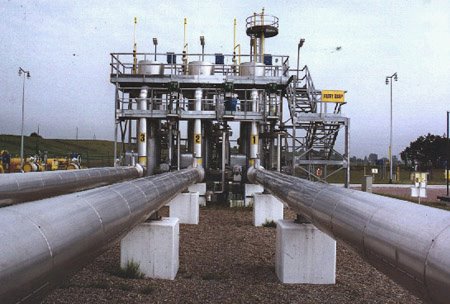
Photo taken at the Compressor site (Late December, 2007)

A letter from a concerned Swansea resident now sits on the desk of the UK Energy Minister...

Dear Mr. Wicks,

I am writing to you as a resident in the Swansea area with grave concerns about a gas compressor station currently under construction at Llangyfelach, just outside Swansea. I am concerned about the proximity of this installation to residential properties, a proposed Strategic Business Park, and a regional hospital at Morriston.

I am sure you will recall that you opened a key valve on this site on November 27th, 2007, in your capacity as UK Minister for Energy. The Felindre Compressor station was approved by the City and County of Swansea Council at the end of 2006. I was concerned at the time that safety at this proposed installation did not receive the careful attention that I and many others felt that it merited.

These concerns were re-ignited when a National Grid public information factsheet came into my possession. This factsheet makes clear that a Hazardous Substances Consent is required for thissite. It is referred to in the leaflet as "standard practice". I enclose a copy of this leaflet for your reference. The planning case file for Felindre, held at the planning offices of City and County ofSwansea Council, makes no reference to any such application for consent ever being lodged.

I addressed my concerns about this situation to the Head of the Planning Department of Swansea Council, a Mr. Bryan Graham, at the start of December of last year. To date I have received no reply. I have also lodged a Freedom of Information Request with theHealth and Safety Executive, who, as you will know, are Statutory consultees on Hazardous Substance Consent applications.

Upon receiving the HSE's reply to my request, I was alarmed to learn that the HSE have"no record of risk assessments or site inspections", and further, that they have no record of any correspondence between themselves and City and County of Swansea in relation to this site.Were you aware, when you were on this site, that you were opening a valve on a site that has no Hazardous Substances Consent?

Given that we the public rely on the HSE's expertise to reassure us that safety has been given due care and attention - which does not appear to be the case here - can you as the Minister for Energy, assure the public in this area that safety is, indeed, paramount, in relation to this site, as the risks it poses to the surrounding area appear at this point to be totally unquantified.

If you as Minister agree that the issue of safety has not been adequately assessed by the HSE, would you support a call for both a moratorium on all construction, and a full public inquiry into this apparent breakdown of the standard process, and can you give assurances that legitimate public concernsabout safety will not disappear down a regulatory black hole?

And if you would not, why not?

Given the gravity of this situation, I await your reply with some urgency.

Yours Sincerely,


Jim Dunckley.


Saturday, January 26, 2008

Just Blame it on the Weatherman...


News coming out of the Brecon Beacons about the damage caused to key protected areas in the Park will come as no surprise to those of us elsewhere along the pipeline route already well acquainted with National Grid's desperate rush to "complete" the pipeline at all costs.

Nor will it surprise people in parts of Scotland either.

In 2003, Transco's contractor Nacap Lawrence was fined £30,000 by SEPA - the Scottish Environment Agency - for silt pollution caused in the River Ythan in North-East Scotland during another pipeline project to connect a gas terminal at Aberdeen.

Seems like Nacap have acquired a very bad habit of doing this kind of thing...

Indeed, in Brecon the problem has become so bad that large areas of topsoil along the pipeline route are quite literally washing away into important rivers like the Towy, Crai and Usk - some of which are protected under the EU Habitats Directive.

The Park's fundamental concern has always revolved around the fact that the construction timetable for the pipeline was far too tight, and the routing flawed, and that this would ultimately compromise both aftercare and safety in large areas of the Park. And as it turns out, the Park Authority was right.

National Grid, meanwhile, have taken to blaming the crap weather for this huge cock-up. But they were warned...

Back in 2005, when the Grid sensitively decided to route their huge pipe through a newly designated Geopark, concerns were raised by various bodies about the viability of routing a pipeline of this size through a sensitive landscape riddled with fragile habitats, steep slopes and unstable landslips.

This little nugget from the HSE in particular makes clear that dodgy weather was a pressing concern for them too;-

Health and Safety Executive Hazardous Installations Directorate

"Pipeline Integrity

Route 12 would involve substantial hill sections to negotiate, and we agree with the description of the difficulties in constructing and testing a pipeline over sloping / rising ground. We would be somewhat concerned that a pipeline laid in sloping ground in one of the wettest areas of the country could be at risk of failure during operation, as a result of ground movement. The UKOPA Pipeline Loss Database (1962 -2004) reports a total of 172 product loss incidents. Of these, five were caused by ground movement withone of these (an 18-inch diameter pipeline) failing as a full-bore rupture with ignition of gas. This is a significant failure given that only nine of the 172 product loss incidents resulted in ignition."


Route 12 was discarded, but given that route 13 (the route chosen) is fundamentally a very similar route, that may not make a lot of difference.

National Grid have buggered up, and they know it. Not only have they routed the pipeline through a sensitive landscape which has been irreperably damaged, but they have also routed the pipeline through a landscape which is so unstable that it poses an ever-present risk to the integrity of the pipe itself.

Maybe this dim realisation that the routing of the pipeline is fundamentally flawed prompted Project Manager David Mercer to tell Welsh Assembly members at a meeting recently that it was actually Exxon that decided the ultimate route in any case - by deciding to site the Terminals in Milford Haven....

Thursday, December 27, 2007

All gassed up, and nowhere to go...

A day after the European Commission agreed to look into the LNG project, a story of great significance to Welsh campaigners appeared on BBC Online.

The UK government decided to throw out National Grid's application to build a Pressure Reduction Installation at Corse, near Tirley. This installation marks the end of Phase 2 of the pipeline project.

And while the timing of this decision is curious enough, it's significance is clear: National Grid have a pipeline - but nowhere to run it to. The UK government have delivered a vote of no confidence in a key part of the project.

Perceptive readers with their critical faculties intact may ask a key question at this point: haven't the BBC been reporting the Grid's line that this pipeline project is complete?

Maybe the BBC were aware of this small conundrum when they decided to tuck this small nugget of info away in the "South-West" section of the BBC England website, where the 90% of those affected by the pipeline would be unlikely to see it...tut tut.
“It is important that we shine light into this darkness.”

The numerous safety and environmental concerns raised by residents at the LNG Terminals and along the pipeline were vindicated last Thursday when the European Committee of Petitions agreed to pass the whole issue to the European Commission for further investigation.

Members of the European Parliament sitting on the Committee sat in stunned silence as Rodney Maile, a resident from Milford Haven, laid out in graphic detail the potential consequences of an accident at the LNG terminals and jetty. While Liz Whomsley, a resident of Trebanos, in the Swansea valley showed, amongst many other things, how the lack of consultation in her area had led to the routing of a section of the massive pipeline through a geologically unstable area and even under a school playing field.

The remarkable proceedings, apparently unprecedented in the history of the Committee, were the outcome of more than 2 months of hard work by Euro MEP Jill Evans and her team, who unearthed breaches of up to 8 EU Directives. A cross-party consensus amongst the numerous political groupings on the Committee meant that it did not even have to be put to a vote.

Nevertheless, a diversity of opinions were expressed, and ordinary residents used to banging their heads against a wall of official silence sat in amazed disbelief as a full debate on the merits and de-merits of LNG unfolded across the floor.

A debate that has certainly never taken place on UK soil.

The LNG project has now been referred to the European Commission, as a matter of urgency. The Commission in turn will investigate the alleged breaches in more detail and report back to the Committee in February.

Monday, December 10, 2007

Brussels to hear anti-LNG petition.

After a brief wait, campaigners against the LNG pipeline and Terminals have confirmation that they will be called to testify to the European Committee on Petitions on December 20th.

If persuaded, they may recommend that the European Commission open an investigation into the project. We shall see.

Thursday, December 06, 2007

What England Doesn't Want, Wales Gets.


I've become convinced that the UK government must a giant map somewhere, where power projects and communities are shifted around like so many pieces in a game of chess. Of course, for people who live nowhere near any of these projects, it's quite easy to be abstract and detached.

For people who have to live in the shadow of them for the rest of their lives, it can be a living hell.

Some communties seem quite happy to accept what's foisted on them. Others take a stand and fight back. And sometimes, they win. The fact that many of those communities happen to be in England, however, can create problems for poorer areas of the UK, where people may be happier to accept a few crumbs off the table.

Take Canvey Island, Essex, for example. The local council took a stand and fought off a proposal by Calor Gas, Centrica and Japan LNG to build a giant LNG terminal in the area. The scheme was earmarked to be operational by 2011. But in October of this year Calor Gas announced that they were withdrawing from the scheme, effectively killing the project.

This created a problem for the UK government. Canvey was provisionally earmarked to bring in 5.4 billion cubic metres of gas every year, a substantial proportion of the UK's overall demand. With the scheme dead, that supply will now have to come from somewhere else.

So goodbye Canvey, and hello Amlwch. And by sheer coincidence this scheme has been earmarked to be up and running by 2011 too! It all fits together so neatly...

Amlwch, however, is already a much bigger project, by Canatxx' own admission;

"When operating the plant is designed to regasify up to 3 bcf per day of LNG. This represents between 25% and 33% of UK daily total demand for gas. It will take 24 hours to discharge a tanker. At peak it is estimated that three tankers would be discharged a week."

With this plant up and running, by the UK government's target date of 2011, Amlwch, combined with Milford Haven in the south, will be importing approximately 50% of the UK's total gas requirement. Anybody who wants to take it out will know where to come.

But with a much lower population density, West and North Wales are much safer bets to site these controversial projects. People are desperate for the jobs, and planners and our representatives are happy to nod them through. So what price a couple of thousand Welsh lives, compared to the much more densely populated areas of the south east of England?

Wednesday, December 05, 2007

A North Wales Pipeline?


Despite objections from Anglesey town councillors concerned with the risk of terrorism and the impact on a local housing estate, the Isle of Anglesey county council today approved American multinational Canatxx's application to build a giant LNG terminal just offshore of the tiny town.

But Canatxx's application to build this giant floating bomb is only part of the story. Their overall plan is to pipe the gas to a strategic storage depot in the North-West of England. Needless to say, the massive size of this depot is only matched by the huge amount of controversy it has generated. 10,000 objections forced Canatxx's application to a public enquiry, the outcome of which is yet to be decided.

And then there is the small matter of the bit in between: the pipeline. In South Wales, the LNG terminals were common knowledge. What was less well known was that a massive, hugely destructive pipeline would be required to transport the regassified LNG to it's final destination in the English midlands, and possibly beyond.

When the UK government says there is a "National Need" for these projects, you can be sure it's not the Welsh nation they have in mind.

In the case of the Canatxx LNG Terminal, the publicly stated plan is to pipe this gas sub-sea to Fleetwood, in Lancashire. But a source within Plaid Cymru has stated that this plan has now changed: it will now run overland across North Wales into England. It's exact route at this point is unknown.

But one thing you can be sure of. The UK government and it's cronies in Wales will do everything in their power to ensure it happens. The safety of local people, or the beautiful landscape will not figure into the equation. And under new plans being cooked up in the bowels of Whitehall a new unnacountable Quango will be created to force through this massive new project, and others like it: the Independent Infrastructure Planning Commission.

There will be no Welsh representation on it.

Some Plaid AMs are already condeming the move, saying that puts us in a worse situation than Tryweryn, some 40 years ago. You have to ask the question: what are we paying for in Cardiff if the Assembly has no power to stop these things happening?

Governor General Peter Hain has thrown his support behind the plan though, which just goes to show that he is a man with two jobs and one plan: to turn Wales into an energy colony.

Sunday, December 02, 2007

Who's been a naughty boy then? - Part 2.


Well, the pipe may be up and running, but it seems that it may be running through a site that has no legal right to operate. A press release sent out on Friday makes clear that National Grid have not applied for a Hazardous Substances Consent to operate the Felindre Compressor site.

So by opening a valve on this very same site last Tuesday, a senior UK Government Minister may well have done so in breach of the law...oops.

Nothing new there then.

Given that they've produced a leaflet making clear that they do require a consent, it'll be interesting to see how they wriggle out of their much vaunted commitment to public safety this time...

Tuesday, November 27, 2007

The Curious Case Of The Minister And The Missing Safety Valve.


National Grid are happy as larry. Pipeline Tsar David Mercer claims today that their "tremendous engineering achievement" is now finally complete. As usual with National Grid, this claim is true, and then it's not true. A testament to Mercer's finely honed ability to twist and wriggle around the real issue, kind of like a worm on a sharp hook.

It may well be true that the pipeline is complete. The stations - without which the pipeline is useless - are another matter. They are far from complete. And when Malcolm Wicks happily flicked his safety valve at Felindre this afternoon, we can only hope that the safety valve in question was the same one that was raised by a Swansea councillor at a planning meeting at the end of last year.

At that farcical planning meeting, during which the Felindre Compressor Station was discussed and "approved", a local Labour Party councillor raised a concern about the amount of safety valves at the proposed station. This concern was based on observations made at a site visit 3 weeks previously. Exactly what was discussed on this site visit is hard to ascertain, as members of the public were excluded. The inference was that there may be a valve missing.
These valves, known in the industry as "block valves" work to isolate sections of pipeline in the event of a leak, or worse, a full blown rupture.

And while the good Councillor was concerned to clarify that there was a valve to protect the Swansea area, he inadvertedly touched on a larger issue. Many concerned residents have raised concerns about the number of safety valves along the pipeline. It's not hard to intuit that, given the length of the pipe and the tremendous pressure it operates at, there should be more than 2 valves along 314 kilometres of pipeline. This concern has never been adequately addressed.

A report commissioned by Ofgem at the end of 2005, for example, costed 2 safety valves along the 196 kilometre length of Phase 2. As it stands, there's only one, at Llanwrda. So what happened to the other one? At a cost of 250,000 quid apiece that's not even half of the cool 600,000 Chief Honcho Steve Holliday was paid last year.

With an estimated 120 tonnes of gas sitting in every mile-long stretch of pipeline, these valves are kind of important...

To put this issue in perspective, consider that Murphy pipelines, the contractor working on the eastern half of Phase 2, constructed another pipeline between Belfast and Derry in Northern Ireland a few years ago. This smaller 112 km pipeline had no less than 5 valves along it's length, even though it was contracted to operate at a lower pressure.

This issue of safety valves, while it certainly perplexed Councillor Roger Smith (Clydach), didn't stop him doing what so many other Labour councillors have done over the last 4 years. Having queried a planning officer who had just told him that the Environment Statement was a "wonderful document" even though "he hadn't read it all" he went ahead and voted for the application anyway.

Go figure.

Friday, November 16, 2007

Euro Petition Handed In...


Jill Evans (Left) and Irish MEP Kathy Sinnot hand in a joint petition to Chair Marcin Libicki

Plaid Euro MEP Jill Evans has now handed in a petition to the European Committee on Petitions. The Welsh petition has been handed in jointly with another one by Irish campaigners who are fighting a planned terminal on the Shannon Estuary.

Thursday, November 15, 2007

A Terminal Problem


Gordon Brown yesterday announced new anti-terror measures, including plans to erect safety barriers around major facilities and also ensure new buildings are made from blast-proof material.

Maybe he'd like to start with the perimeter fence around the Dragon LNG terminal...

Friday, November 09, 2007

Currently winging it's way to a number of press outlets - but you heard it here first...

Ymgyrchwyr yn Erbyn y Beipen Nwy LNG yn Baratoi i Fynd i Ewrop.

Mae ymgyrchwyr yn erbyn y Terminalau a beipen nwy LNG sy’n torri trwy cymru yn baratoi i gymryd eu hachos i’r Undeb Ewropeaidd, gyda cymorth yr Aelod Seneddol Ewropeaidd, Jill Evans.

Mae Ms Evans wedi ymgynghori ymgyrchwyr o ardaloedd Penfro, Abertawe a Gastell Nedd fod nhw’n gallu gosod deiseb gyda’r Pwyllgor Deisebion ym Strasbourg, ac ei fod yn bosib y fydden nhw’n gael ymchwiliad mor gynnar a Mis Rhagfyr.

Meddai llefarydd ar ran yr Ymgyrchwyr, Jim Dunckley, "Mae Jill yn Aelod Seneddol Ewropeaidd gyda record dda o gymryd lan achosion grwpiau cymunedol ac amgylchfydol dros y flynyddoedd. Roedd hi’n mwy na hapus i siarad gyda ni a helpu ni cymryd ein hachos i Ewrop. Mae hi wedi ymgynghori ni am y bosibiliad fod y brosiect, neu rhannau o’r brosiect, yn redeg yn erbyn nifer o Directives yr Undeb."

"Er mai’r brosiect hon yn gael ei gomisiynu ar hyn o bryd, mae dal lot o gwestiynau sydd heb eu hateb gyda ni, yn arbennig am ddiogelwch a’r ffordd mae’r brosiect wedi cael ei roi trwy’r drefn cynllunio. Gan mai’r awdurdodau yng Nghaerdydd a Llundain wedi methu ni yn gyfangwbwl, teimlai fod gyda ni ddim dewis ond i fynd i Ewrop. Mae gyda ni lot fawr o dystiolaeth nawr a’r bosibiliad o gael y gyfle i dystio.

"Mae’n siom fawr i ni fod ein llywodraeth etholedig cyntaf yng Nghymru wedi methu sefyll lan i National Grid er mwyn diogelu ein cymunedau . Mi wnaethon ni ysgrifennu at y cyn Ysgrifennydd yr Amgylchfyd, Carwyn Jones i galw arno fe i "Galw Mewn" y Brosiect hon a wnaeth e anwybyddu ein llythyron. Mae’n eitha glir i ni erbyn hyn fod y Blaid Llafur yn hapus i roi Brydain yn gyntaf a werin bobl Cymru yn ail."

--Diwedd--


Pipeline Campaigners Take Their Fight to Europe.

Local campaigners from communities affected by the giant LNG pipeline project crossing Wales have teamed up with Plaid Euro MEP Jill Evans to take their case to the European Union.

Local campaigners Liz Whomsley and Jim Dunckley and other affected residents are preparing to lodge a petition with the European Committee of Petitions, and have been advised by Ms Evans and her team that the LNG pipeline project may be in breach of certain EU directives.

Jim Dunckley said: " Jill Evans is a Member of the European Parliament with a long-standing history of representing community and environmental groups, and she was more than happy to meet with us and take up our case. She has advised us that we can now lodge a formal petition, and that the Petitions Committee may invite representatives over to testify to the Committee as early as the middle of December, which is great news."

"Many of us feel that the democratic process in Wales and the rest of the UK has let us down badly, and that we are given no option but to try outside the UK. We attempted to get the relevant parts of this project "called in" by former environment minister Carwyn Jones, who refused to even meet with us or respond to many of our letters."

"There are still many unanswered questions around this project, and with the prospect of further pipeline and energy projects in Wales, a public enquiry is urgently needed. National Grid have trampled on many of our communities and ignored legitimate concerns. We need to make sure it never happens again."

--Ends--

Wednesday, October 31, 2007

Promises, Promises...


Well, they told us all these wonderful new gas import projects would be up and running in time, they told us the high prices over the last two years would come down. They told us all these wonderful projects would guarantee "security of supply" to Industry and the Consumers of Britain.

And they told us we could still use our Christmas tree lights and put the kettle on when the ads come on during Corrie. And they told us wrong. We're now told that we face "another winter of soaring prices and power shortages". Better get used to it. The DisUnited Kingdom sits at the end of a pipeline network that starts in Russia, and North Sea gas reserves are running down fast.

In effect, North Sea gas provided the UK with a kind of "supply cushion" that, to some extent, insulated us against the vagaries of the international energy markets. With these reserves now in rapid decline, those days are effectively over. Now we will pay the real price of privatisation.

But for the free-market diehards who have pushed this project, LNG is a wonderful thing. New technology, bigger ships and massive LNG terminals will allow gas to become a truly global trade. Middle Eastern producers like Qatar, in particular, are laughing all the way to the Royal Bank of Scotland. The world is now their oyster.

But what about the "contracts" that have been signed to bring in gas to Milford Haven, Teeside or the Isle of Grain? Milford Haven may not be up and running, but industry insiders say that the other two terminals are running below capacity.

So why are forward prices for gas and electricity already up some 30%?

When the government was crowing on about how these new LNG terminals would ensure a plentiful supply of gas for the foreseeable future, what they forgot to mention was that the contracts to ship gas into these terminals include "diversion clauses" that mean that ships can be diverted to other, higher priced markets, where the return is higher. The Shippers call the shots, not the government, and they can go where they damn well please.

These LNG privateers are now roaming the high seas in search of the highest return. They will come to Britain in the end, but not quite yet. They'll wait for prices to rise here first, so that they can make a decent killing.

But for now, with better returns to be had in Japan and South Korea, we'll just have to accept that, in the new, globalised, privatised, energy scarce world we are living in, winter price spikes are going to become business as usual.

Tuesday, October 09, 2007

LNG Jack-up accident: Something Deeper At Work?


Let's picture the scene: A major Seaway on the West coast of the UK. A massive energy project under a tight construction schedule. An accident occurs involving a "Jack-up" Barge, which begins to list precariously into the sea. The workers, mostly Dutch, are quickly evacuated.

Are we talking about Milford Haven?

Nope. We're talking about the Solway Firth, on the West Coast of Scotland. Just over three weeks ago, a similar jack-up accident occured, under remarkably similar circumstances. Thirty eight contractors working on the massive Robin Rigg offshore wind-farm project were airlifted to safety in that case.

Contractors working on South Hook were not so lucky, and the Big Welsh Gas Project has now claimed it's first casualty. So what's behind this sudden spate of accidents?

In the case of Robin Rigg, German energy giant EON told a local coastguard that the rig had actually punctured through the sea bed. In industry parlance, this is known as "foundation failure." Jack-up barges, supported on four legs, are adjustable to allow them to rest securely on the sea bottom. But accidents do happen in the industry. As the Solway puncture occured, the rig listed, in this case at an angle of 35 degrees.

And not dissimilar to the 45 degree tilt reported at Milford...

The parallels don't end there either. The Dutch company which owns the Solway barge, SMIT International, recently sent another jack-up, TAKLIFT 7, to Milford Haven to work on the South Hook Jetty. These guys get about, don't they...

Needless to say, the Solway accident prompted the intervention of the Health and Safety Executive, as it has in Milford Haven. But in the case of South Hook, all the authorities seem to be keeping their cards close to their chests. No doubt the magic mantra; "20% of the UK's gas supply" has been whispered in the ears of the tiny HSE team assigned to this huge project, and they've shut up like little clams...

So rather than wait for the HSE to open up, let's be a little more pro-active and take a look at the HSE's own Industry guidance. In 2004, the Offshore Division of the HSE's Hazardous Installations Directorate produced a Science and Technology Strategy Document" which looked at precisely this issue of foundation failure.

This strategy was produced in relation to the newly developing Offshore Wind industry, but as the report pointed out 3 years before these two accidents occured; "There have already been potentially serious accidents (heavy lift crane collapse and jack-up foundation failure during site investigation)" and that "Jack-up barges have a history of structural and foundation failures when engaged in inshore and near-shore construction work."

"There is a need to determine the adequacy of current practices for the design and operation of construction barges and, if found inadequate, work with the industry to develop guidance on good practice."

Was such guidance developed in relation to LNG?

Given that the Milford Haven Port Authority has now finally given way to the demands of concerned locals and the Safe Haven group and agreed to release the Risk Assessments for the South Hook jetty, an inquiry into the causes of this particular incident seems particularly pertinent...